 |
| Village Health Workers/Educators and MTW Cambodia Team in Angke Jeay Village |
Wednesday, June 24, 2015
MTW Teaching Team in Angke Jeay Village

The "Angke Jeay Village Players" Starring Pastor Luke and Sokha

Today the lesson was on "Sexually Transmitted Infections (STI's)" and Pastor Luke and Sokha conducted a role play which depicted people sitting around drinking in a bar and then the man went off with a prostitute. Next scene is in the clinic when the man and his wife are having symptoms of an STI. Lots of laughter and fun but the students and all got the point. Thank-you Pastor Luke and Sokha for being brave enough to act out this scene that is very prevalent here in Cambodia as well as all over the world.
The students learned about the signs, symptoms, treatment and prevention of certain STI's. They also created their own Flip Charts (which are being laminated) and presented their topics to the group.
One of the most important lessons learned was that God created sex and set rules to guide us in using this gift. Our culture has ignored these rules, distorting the place of sex in our lives and is paying a terrible price for it! If everyone lived by God's guidelines for love, sex and marriage, we would not suffer from these problems.
 |
| Sokha leading music before the lesson |
 |
| Sokha teaches about "Adam and Eve and Marriage" |
 |
| VHW Group Presentation |
 |
| VHW Group Presentation |
 |
| VHW Group Presentation |
Lunch with Pastor Luke and Sokha in Angke Jeay Village

Tuesday, June 23, 2015
VHW Class in Angke Jeay Village: What is Dengue and Dengue Hemorrhagic Fever?
 |
| Morgan and Pastor Luke working with small group VHW's |
 |
| Pastor Samut working with small group VHW's |
 |
| Karen, Sokha, and Pastor Samut teaching the class |
 |
| Brittany working with small group VHW's |
Dengue Fever and Dengue Hemorrhagic Fever (DHF)
Dengue is transmitted to people by the bite of an Aedes mosquito that is infected with a dengue virus. The mosquito becomes infected with dengue virus when it bites a person who has dengue virus in their blood. The person can either have symptoms of dengue fever or DHF, or they may have no symptoms. After about one week, the mosquito can then transmit the virus while biting a healthy person. Dengue cannot be spread directly from person to person.
What are the symptoms of the disease?
The principal symptoms of dengue fever are high fever, severe headache, severe pain behind the eyes, joint pain, muscle and bone pain, rash, and mild bleeding (e.g., nose or gums bleed, easy bruising). Generally, younger children and those with their first dengue infection have a milder illness than older children and adults.
Dengue hemorrhagic fever is characterized by a fever that lasts from 2 to 7 days, with general signs and symptoms consistent with dengue fever. When the fever declines, symptoms including persistent vomiting, severe abdominal pain, and difficulty breathing, may develop. This marks the beginning of a 24- to 48-hour period when the smallest blood vessels (capillaries) become excessively permeable (“leaky”), allowing the fluid component to escape from the blood vessels into the peritoneum (causing ascites) and pleural cavity (leading to pleural effusions). This may lead to failure of the circulatory system and shock, followed by death, if circulatory failure is not corrected. In addition, the patient with DHF has a low platelet count and hemorrhagic manifestations, tendency to bruise easily or other types of skin hemorrhages, bleeding nose or gums, and possibly internal bleeding.
What is the treatment for dengue?
There is no specific medication for treatment of a dengue infection. Persons who think they have dengue should use analgesics (pain relievers) with acetaminophen and avoid those containing aspirin. They should also rest, drink plenty of fluids, and consult a physician. If they feel worse (e.g., develop vomiting and severe abdominal pain) in the first 24 hours after the fever declines, they should go immediately to the hospital for evaluation.
Is there an effective treatment for dengue hemorrhagic fever (DHF)?
As with dengue fever, there is no specific medication for DHF. It can however be effectively treated by fluid replacement therapy if an early clinical diagnosis is made. DHF management frequently requires hospitalization. Physicians who suspect that a patient has DHF may want to consult the Dengue Branch at CDC, for more information.
Where can outbreaks of dengue occur?
Outbreaks of dengue occur primarily in areas where Ae. aegypti (sometimes also Ae. albopictus) mosquitoes live. This includes most tropical urban areas of the world. Dengue viruses may be introduced into areas by travelers who become infected while visiting other areas of the tropics where dengue commonly exists.
What can be done to reduce the risk of acquiring dengue?
There is no vaccine or medicine for preventing dengue. The best preventive measure for residents living in areas infested with Ae. aegypti is to eliminate the places where the mosquito lays her eggs, primarily artificial containers that hold water.
Items that collect rainwater or to store water (for example, plastic containers, 55-gallon drums, buckets, or used automobile tires) should be covered or properly discarded. Pet and animal watering containers and vases with fresh flowers should be emptied and cleaned (to remove eggs) at least once a week. This will eliminate the mosquito eggs and larvae and reduce the number of mosquitoes present in these areas.
Using air conditioning or window and door screens reduces the risk of mosquitoes coming indoors. Proper application of mosquito repellents containing 20% to 30% DEET as the active ingredient on exposed skin and clothing decreases the risk of being bitten by mosquitoes. The risk of dengue infection for international travelers appears to be small. There is increased risk if an epidemic is in progress or visitors are in housing without air conditioning or screened windows and doors.
http://www.cdc.gov/dengue/fAQFacts/index.html
Teaching Village Health Workers/Educators in Angke Jeay Village. What is Malaria?
 |
| Transmission of Malaria and Dengue |
 |
| Prevention of Malaria and Dengue |
MALARIA
Malaria is transmitted by the plasmodium parasite, which
is injected into a person’s blood through the saliva of an infected mosquito.
(These mosquitoes bite when after the sun goes down and more frequently found
in the rural areas.) It then travels to
the liver where it will mature and reproduce. When the parasite matures, it
will infect red blood cells until they burst. Then, newly developed parasite
from the red blood cells will spread, and infect more red blood cells.
Signs
and symptoms: In
most cases, the signs and symptoms of malaria will begin 8-25 days after the
mosquito bite. However, those who have taken medication to prevent infection
may have an extended incubation period. (Yes- you can still get malaria even
though you have taken medication to prevent it.)When the infected red blood
cells spread throughout the body, the cells will eventually die off. This can also
lead to liver infection. Sometimes the infected red blood cells become
"stickier" than usual and clot easily, which can affect blood flow to
the brain.
The severity of the signs and symptoms of malaria may depend upon
three factors: the type of malaria, your immune system, and health of your
spleen.
There are 5 types of malaria. These include P. Vivax, P.
Malaria, P. Ovale, P. Falciparum, and P. Knowlesi.
During a malaria infection, red blood cells rapidly die,
and the spleen may not be able to keep up with the demand, leading to sepsis
and organ failure. Notice an enlarged spleen, which can happen when the spleen
is overwhelmed by the amount of dead red blood cells and becomes enlarged.
The classical (but
rarely observed) malaria attack lasts 6-10 hours. It consists of
a
cold stage (sensation of cold, shivering)
a
hot stage (fever, headaches, vomiting; seizures in young children)
and
finally a sweating stage (sweats, return to normal temperature, tiredness).
Classically
(but infrequently observed) the attacks occur every second or third day.
More commonly, the
patient presents with a combination of the following symptoms:
Fever
(can be up to 104 degrees (40 C)
Chills
Sweats
Headaches
Nausea
and vomiting
Body
aches
General
malaise
Diagnosis—You
will need to get a rapid diagnostic blood test (RDT) as soon as you develop
symptoms. If the initial diagnostic evaluation is negative,
follow-up testing should be done each day for two more days.
Treatment—Medication
such as Chloroquine
http://www.cdc.gov/malaria/about/disease.html#uncomplicated
http://www.cdc.gov/malaria/about/disease.html#uncomplicated
 |
| Morgan, MTW Intern & Nursing student--assisting VHW students as they teach class |
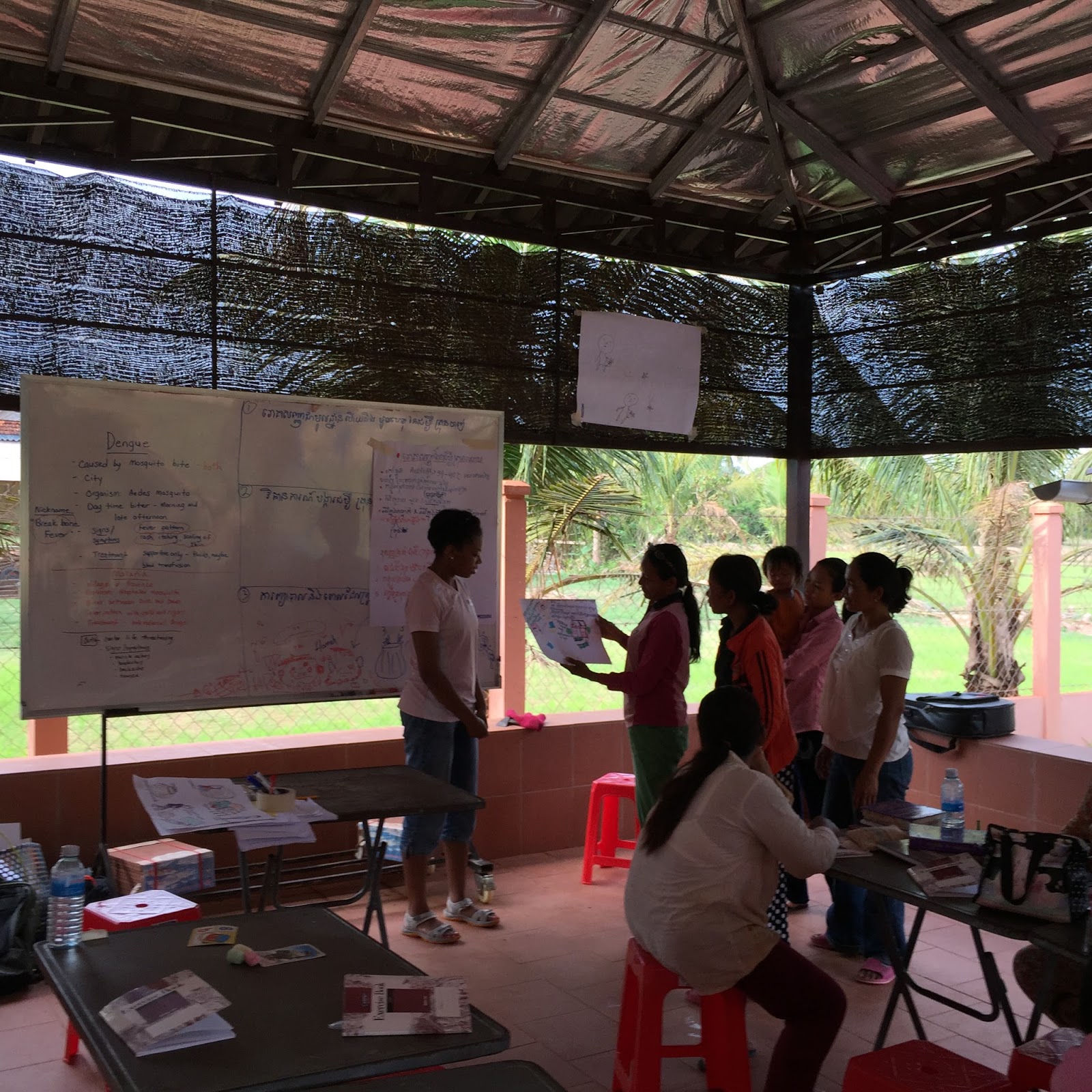 | |
| Brittany, MTW Intern & Medical student-- assisting VHW students as they teach class |
Meet the Village Midwife for Angke Jeay Village and the Commune....
This Village and Commune Midwife was trained by a famous Khmer physician and after the Khmer Rouge she worked in the Refugee Camps for the Red Cross and WHO.
Sokha and I were able to meet with her to ask what STI's/STD's she was treating in the village and what treatment did she offer. It was pretty similar to those that we treat in the USA including the treatment..
A few days later we visited her at the Health Center. We learned each prenatal visit costs 75 cents. A vaginal delivery costs...$12.50.
Sokha and I were able to meet with her to ask what STI's/STD's she was treating in the village and what treatment did she offer. It was pretty similar to those that we treat in the USA including the treatment..
A few days later we visited her at the Health Center. We learned each prenatal visit costs 75 cents. A vaginal delivery costs...$12.50.
 |
| Karen and Midwife |
 |
| Sokha and Hannah with Midwife at the Health Center |
 |
| Sokha and Hannah with Midwife at the Health Center |
So Where Should I Buy Gas For My Moto?
 |
| Gas Station in Angke Jeay Village |
 |
| VHE Students leaving after a day of class |
 |
| VHE Students leaving after a day of class |
Subscribe to:
Posts (Atom)